Speaker: Dy Outdom
Date & Time: Wednesday, 8th july 2026, 10:30–11:30 a.m.
Venue: SIC discussion room,Department of Mathematics, Universitas Gadjah Mada
The Algebra Laboratory held its Weekly Algebra Student Seminar featuring Dy Outdom, who delivered a talk entitled “An Introduction to the Study of Derivations on Rings and Algebras.” The seminar introduced the fundamental concept of derivations and demonstrated how the familiar notion of differentiation from calculus naturally extends to abstract algebra.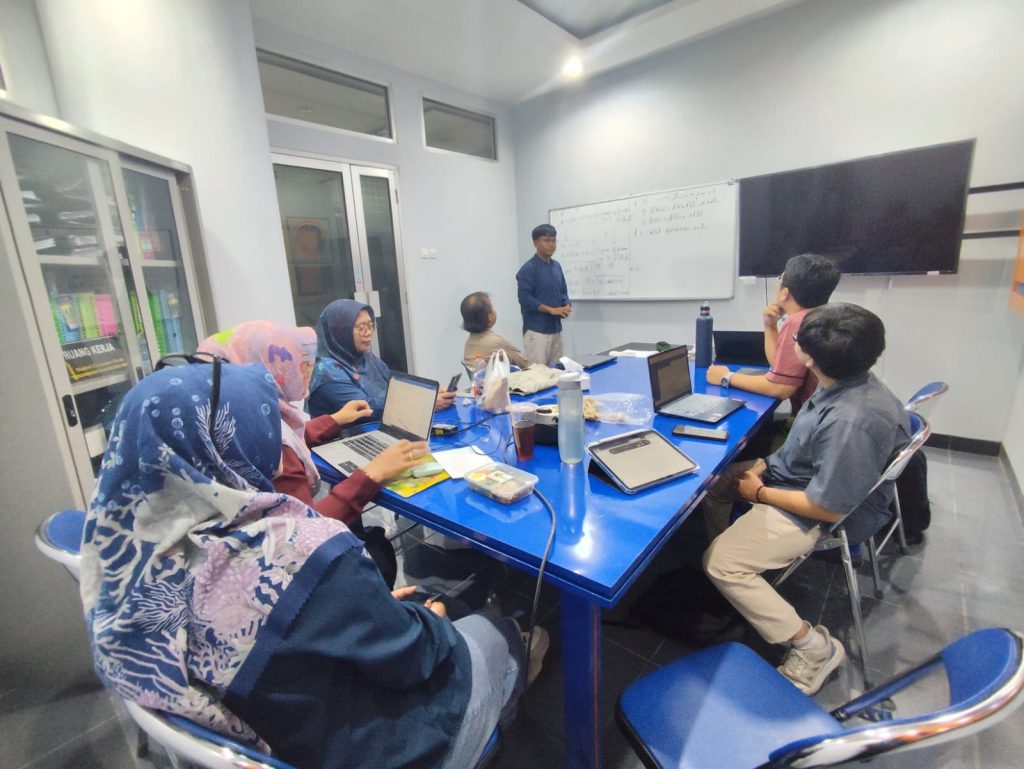
The presentation began with the concept of the derivative of real-valued functions studied in elementary calculus. The speaker highlighted two essential properties of differentiation—linearity and the Leibniz (product) rule—and explained that these two identities provide the foundation for the algebraic definition of a derivation. This motivation illustrated how a concept from analysis can be generalized to rings and algebras without relying on limits or continuity.
Building on this idea, the speaker introduced the formal definition of a derivation on a ring and an algebra, together with several basic examples. He explained that a derivation is an additive map satisfying the Leibniz rule, making it an algebraic analogue of differentiation. The seminar emphasized that this simple definition has far-reaching consequences in many branches of modern algebra.
To illustrate the theory, the speaker presented a proof that every derivation on the ring of integers Z is the zero derivation. Using elementary arguments and the defining properties of derivations, he showed that no nontrivial derivation exists on the integers. This result was then extended to the field of rational numbers Q, where it was similarly proved that every derivation must alsobe trivial. These examples demonstrated how the algebraic structure of the underlying ring strongly influences the existence of derivations.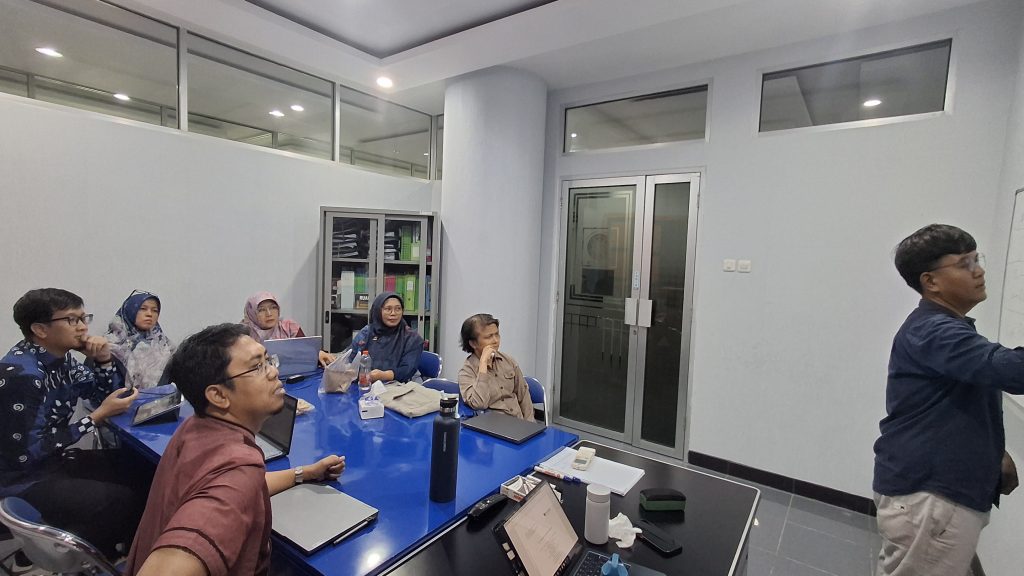
The seminar concluded with a discussion of several directions for future study. The speaker briefly introduced derivations on modules, associative algebras, and more general algebraic structures, highlighting their connections to ring theory, Lie algebras, functional analysis, and noncommutative algebra. He also shared several open questions and current research perspectives, encouraging participants to explore the rich and active field of derivation theory.