The Summer School 2026 on Post-Quantum Cryptography, Cybersecurity, Analysis, and Probability officially commenced with two days of academic activities hosted by Universitas Gadjah Mada and Universitas Muhammadiyah Malang. The program brought together leading researchers and participants to discuss recent developments in mathematics, cryptography, cybersecurity, artificial intelligence, and coding theory.
Pre-School Lecture:
May 12, 2026:
Venue: Universitas Gadjah Mada (Hybrid)
This pre-school opened with a lecture by Prof. Shakir Ali on “Application of Algebraic Structures in Coding Theory and Cryptography.” In his presentation, Prof. Ali demonstrated how algebraic structures such as groups, rings, and fields provide the mathematical foundation for modern coding theory and cryptographic systems. He highlighted the role of abstract algebra in designing secure communication protocols, constructing error-correcting codes, and developing cryptographic algorithms capable of addressing emerging security challenges.
May 13, 2026:
Venue: Universitas Gadjah Mada (Hybrid) and May 13, 2026 ( Venues: UM Malang)
Dr. Uha Isnaini from Universitas Gadjah Mada presented “Post-Quantum Cryptography – The Future of Cryptography.” His lecture introduced the challenges posed by quantum computing to current cryptographic systems and provided an overview of post-quantum cryptography, highlighting the mathematical principles behind cryptographic algorithms designed to remain secure against quantum attacks.
Official Opening and Day 1 – May 13, 2026
Venue: Universitas Gadjah Mada

The Summer School officially opened with an opening report delivered by Dr. Uha Isnaini, Ph.D., Chair of the Organizing Committee, who welcomed participants and outlined the objectives of the program. The ceremony continued with opening remarks by Dr.rer.nat. Wiwit Suryanto, S.Si., M.Si., Vice Dean for Research and Community Service, Faculty of Mathematics and Natural Sciences, who formally declared the Summer School 2026 open.
The academic program began with a keynote lecture by Prof. Seok-Won Lee from Ajou University, South Korea, entitled “Toward Collective Intelligence in the Days of AI: A Collaborative Framework for Evidence-Driven Data Requirement Engineering and Data Quality Assessment for Machine Learning-Based Safety-Critical Systems.” His presentation discussed how collaborative software engineering and data quality assessment are becoming increasingly important for the development of reliable AI systems, particularly in safety-critical applications.
The second lecture was delivered by Dr. Nopendri (online) from Telkom University, Indonesia, who presented an introduction to finite fields and coding theory. He explained the mathematical foundations of finite fields and demonstrated their importance in constructing error-correcting codes used in modern digital communication.
The final lecture of the day was presented by Dr. Santi Indarjani (online) from Poltek SSN, Indonesia, on “Past, Present, and Future of Cryptography.” She reviewed the historical development of cryptography, its current applications in digital security, and the future direction of cryptographic research in response to rapidly evolving cybersecurity challenges.
Tuesday, July 14, 2026:
The program continued with Prof. Seok-Won Lee, who presented a session on Security Risk Assessment, discussing the importance of identifying and assessing security risks in technological systems.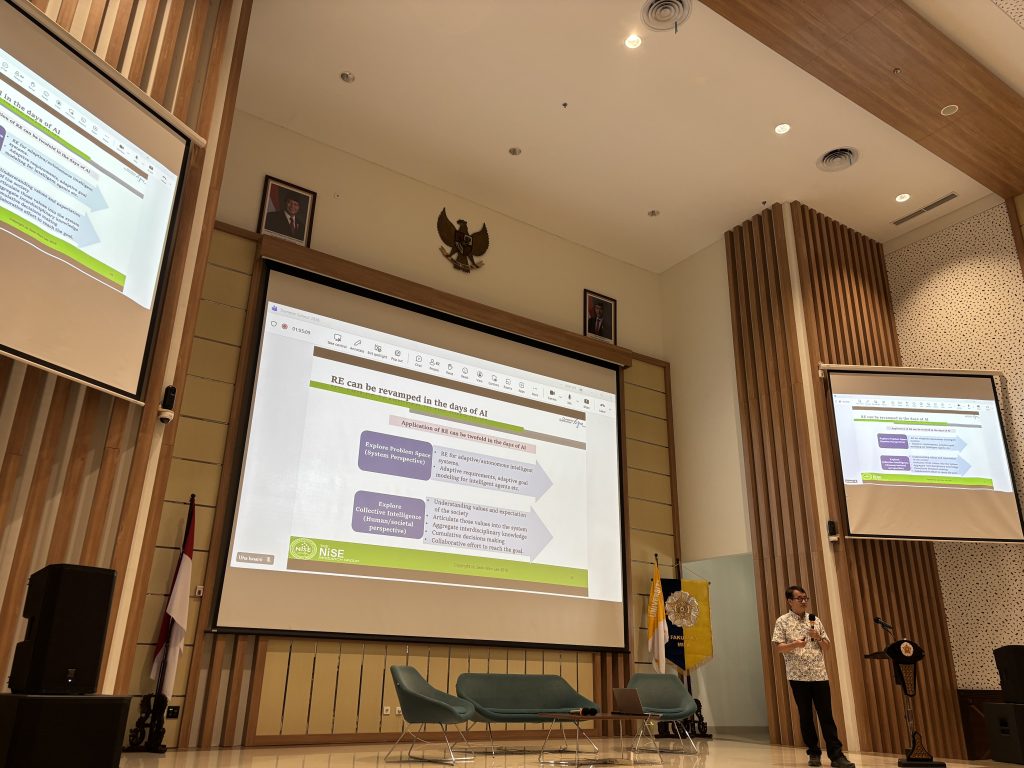
The next session was delivered by Dr. Eng. Khoirul Anwar on Classical and Quantum Error Correction Codes. The session introduced error-correction techniques in both classical and quantum settings, highlighting their role in reliable information transmission.
 The program also featured Septia Ulfa Sunaringtyas,M.T., who delivered an online session on Security Policy, focusing on the policy aspects related to information security andcybersecurity.

Wednesday, July 15, 2026 (fully online):
The Summer School continued online with a lecture by Hong Nankun, Ph.D. on the Application of Number Theory in Cryptography. The session highlighted the role of number-theoretic concepts in the development and analysis of cryptographic systems.
Following the morning break, Frederic Ezerman, Ph.D. presented “PQC: Algorithms, Standards, Use Cases.” The lecture introduced post-quantum cryptography from the perspectives of algorithms, standardization, and practical applications.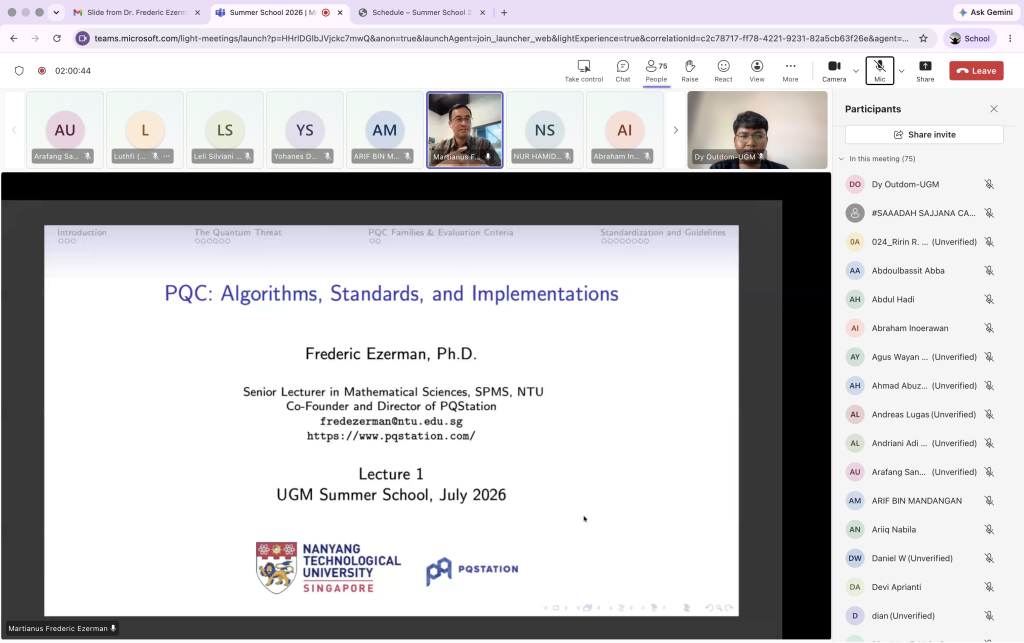
After the prayer and lunch break, Adamas Aqsa Fahreza, B.Sc. delivered a session entitled “Using PQC in Public Key Infrastructure.” The presentation discussed the integration of post-quantum cryptographic techniques into public key infrastructure.
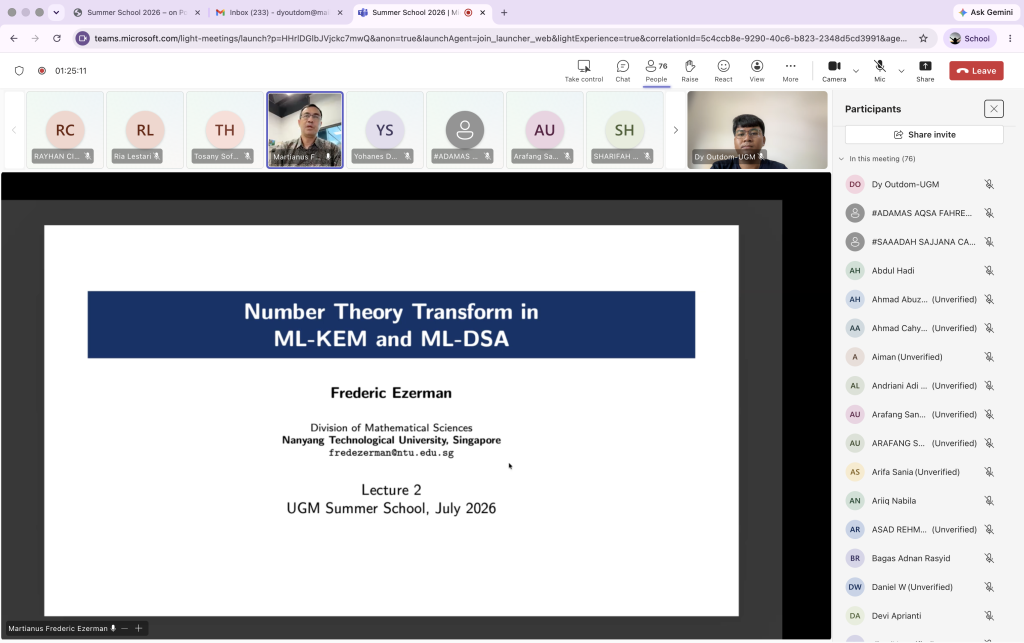
The final session of the day was again presented by Frederic Ezerman, Ph.D., focusing on “Number Theory Transform in ML-KEM and ML-DSA.” The session connected number-theoretic techniques with the mathematical structures underlying ML-KEM and ML-DSA.
 Thursday, July 16, 2026 (fully online):
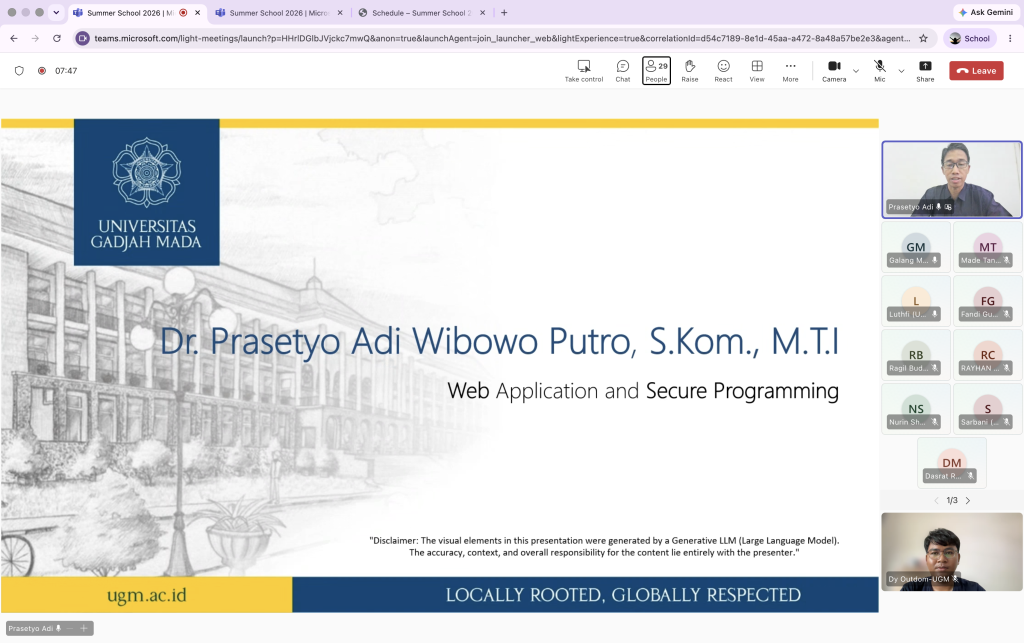
The program continued with an online session by Dr. Kabul Kurniawan. The schedule also featured Dr. Prastyo Adi Wibowo Putro, who presented “Web Application & Security Programming,” introducing participants to security considerations and programming practices for web applications.

 Friday, July 17, 2026 (fully online):
The final sessions included Abdullah Hanifan, M.Kom., who delivered lectures on Database Security and Network Security. The sessions addressed security considerations in databases and computer networks, providing participants with further perspectives on protecting information systems and digital infrastructure.
