Lecturer: Prof. Bharath Sethuraman
Emeritus Professor of Mathematics, California State University, Northridge (USA)
Organized by: Algebra Research Group,
Department of Mathematics, Universitas Gadjah Mada
Dates: 3rd, 10th, 17th, and 24th November 2025
Platform: Zoom
The Algebra Research Group of Universitas Gadjah Mada hosted a four-week online lecture series delivered by Prof. Bharath Sethuraman. The lectures attracted participants from various universities, offering a clear and accessible introduction to fundamental concepts in algebraic geometry and their deep connections to modern applications.


Prof. Sethuraman began the series by introducing the zero set of a polynomial and explaining its relation to the affine space. He discussed the structure of polynomials over the complex numbers ℂ and developed the notion of algebraic sets along with the ideals defining them. He then presented Hilbert’s Nullstellensatz, emphasizing its central role in establishing the correspondence between ideals and varieties. Before concluding the first session, he highlighted foundational topics in commutative algebra—such as integral extensions, Noether normalization, projective spaces, and projective varieties—that would be developed in subsequent lectures. He also mentioned a broad range of applications of algebraic geometry, including physics, cryptography, error-correcting codes, robotics, computer graphics, and biology.
 The second lecture opened with a brief review of the key ideas from the previous week. Prof. Sethuraman then transitioned to the concept of projective space, defining it as the set of lines passing through the origin. He illustrated this using visual examples in 3-dimensional space, showing how classical conic sections — circles, ellipses, hyperbolas, and parabolas — can be viewed as the same geometric object in the projective plane P^2(R). Near the end of the lecture, he introduced the notion of integral ring extensions, recalling definitions and fundamental results to prepare for deeper discussions.



Responding to participant requests, Prof. Sethuraman opened the third lecture with a more detailed explanation of projective spaces, especially P2(C).
He shared a philosophical perspective often taught in geometry courses:
“Moral: In P^2(C), the fundamental objects are lines through the origin in C^3. If we want to represent these fundamental objects as points — as our human intuition prefers —we examine where these lines intersect the planes x_0=1, x_1 = 1, x_2. Each plane captures most of the space, and together, they capture all of P^2(C).”
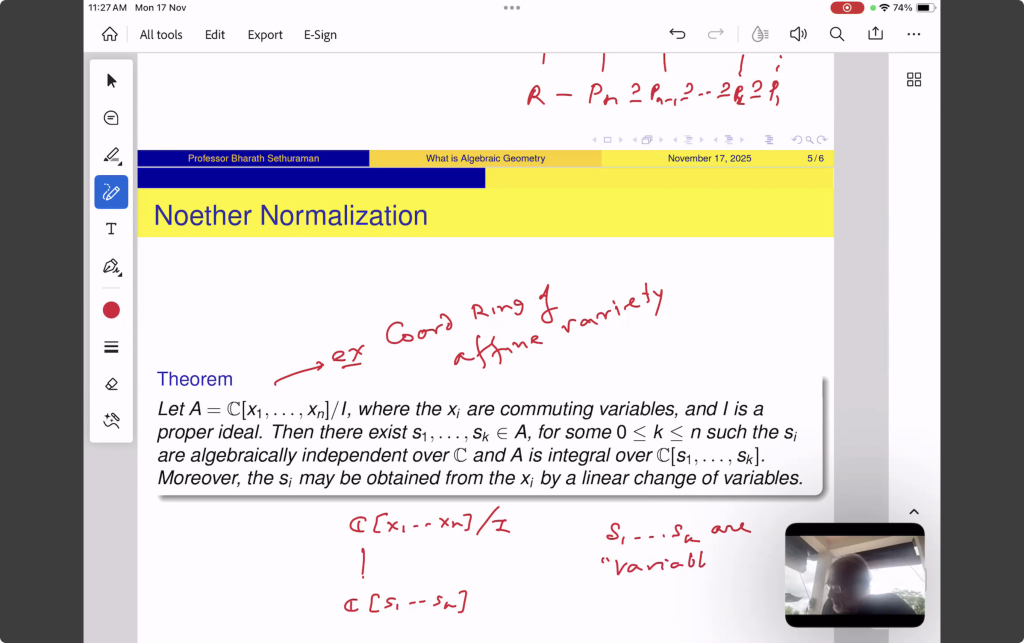
The lecture then moved to a clearer explanation of homogeneous polynomials, prompted by a question from Prof. Indah Emilia Wijayanti. Prof. Sethuraman discussed how homogenization ties affine and projective geometry together. He concluded by returning to integral extensions and introduced the celebrated Noether Normalization Theorem, laying the groundwork for the final lecture.


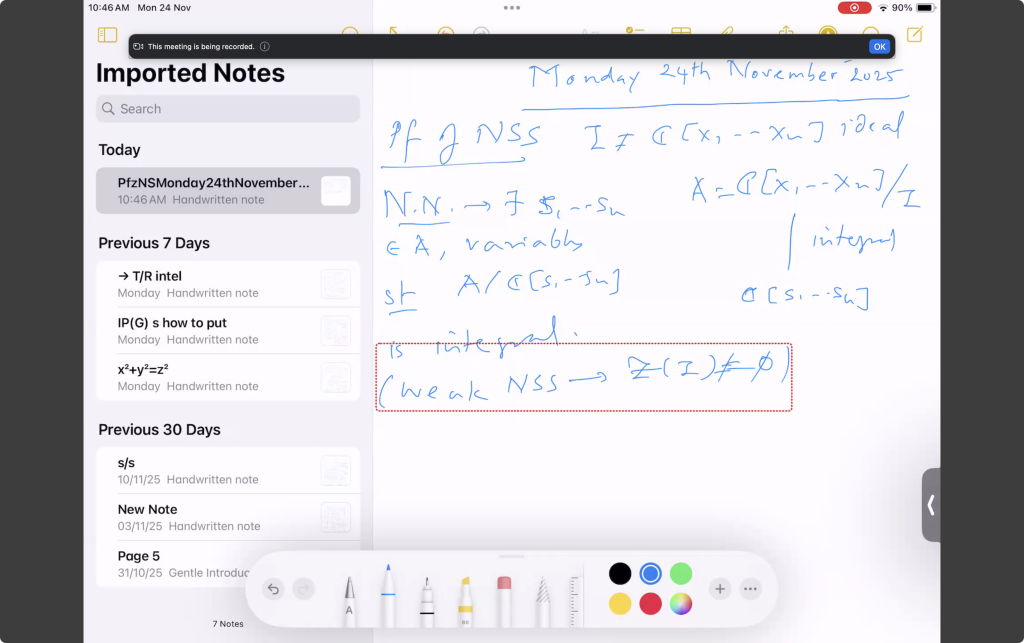
In the final lecture, Prof. Sethuraman began with the statement and proof of the Weak Nullstellensatz, ensuring participants gained a conceptual and computational understanding. He then progressed to the Strong Nullstellensatz, demonstrating the proof using Rabinowitsch’s trick, a clever algebraic method widely used in textbooks. With remaining time, he revisited the Noether Normalization Theorem, providing a complete proof along with concrete examples to clarify its importance in algebraic geometry and commutative algebra.