Location: Room 501, FMIPA Building, 5th Floor, UGM.
Date: Wednesday, March 4, 2026
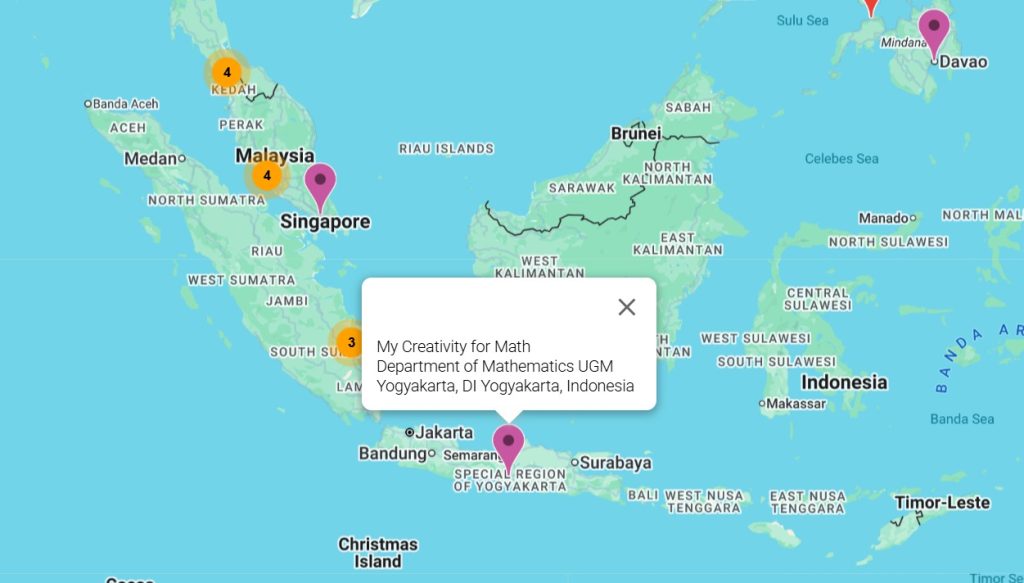
In celebration of the International Day of Mathematics (IDM) 2026, the Mathematics community at Universitas Gadjah Mada organized a special event combining a colloquium, cluster discussions, and a reflective activity titled “The Wall of Reality & Hope.” The event aimed not only to share research ideas but also to create a space for PhD students to reflect on the challenges and motivations of their academic journeys.
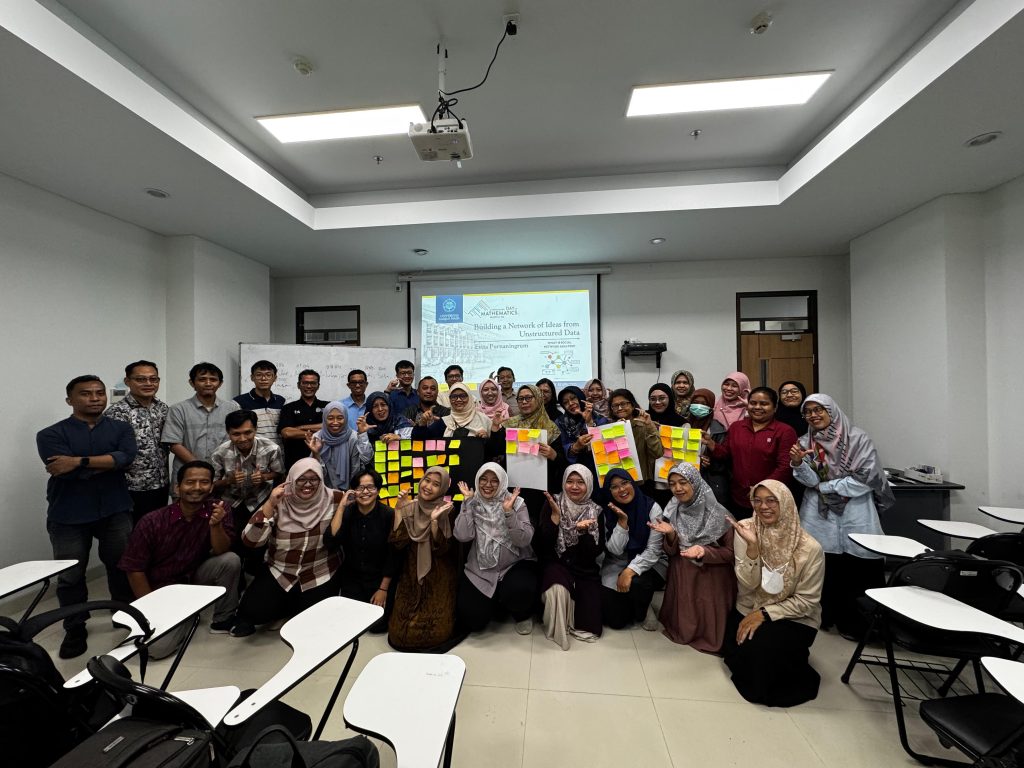
The Colloquium Session featured a talk by Evita Purnaningrum, S.Si., M.Si., entitled “Building a Network of Ideas from Unstructured Data.” The presentation discussed approaches to extracting meaningful connections from unstructured data and how such methods can help organize complex information into structured networks of ideas.
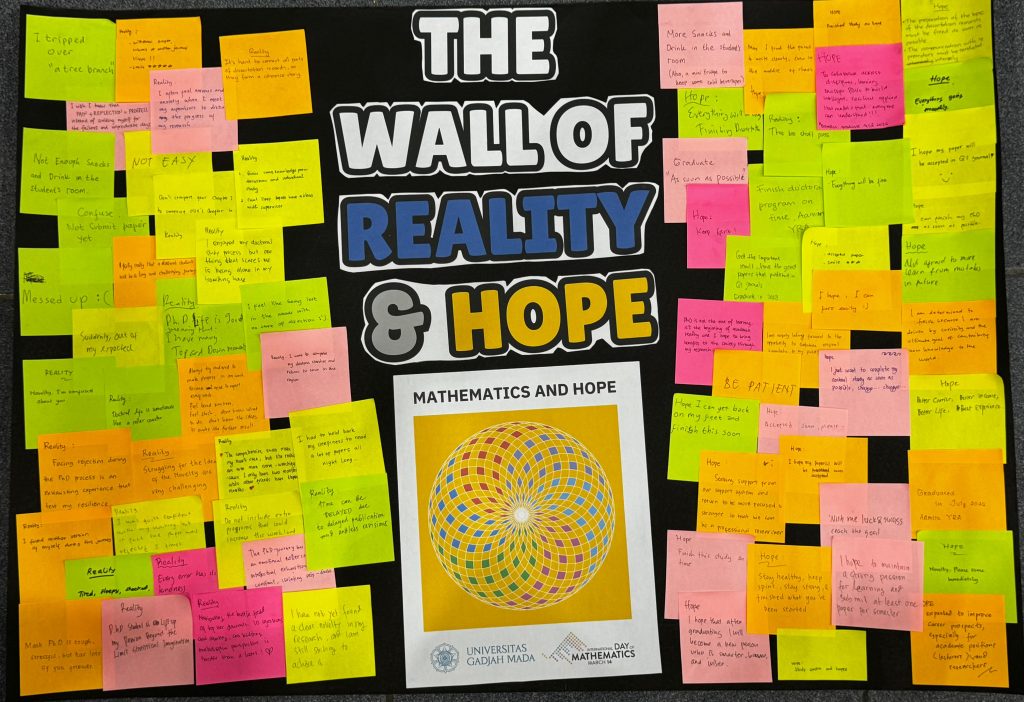
Following the colloquium, participants joined the activity “The Wall of Reality & Hope,” where PhD students shared brief reflections on their research journeys. In this activity, participants wrote one sentence describing the reality of their PhD experience, including challenges and struggles, and another sentence expressing their hope and motivation for continuing their research. This interactive session encouraged participants to connect, support one another, and reflect on the purpose behind their academic efforts.
During the Algebra Cluster discussion, our student Muhammad Irfan Arsyad Prayitno presented his topic entitled “Adjacency, In-Degree Laplacian, and Out-Degree Laplacian Matrices of Digraphs.” In his presentation, he explained how different matrix representations of a digraph can be constructed and transformed from one form to another. Using a simple example of a digraph known as the directed cyclic sun graph, he demonstrated the relationships between adjacency matrices, antiadjacency matrices, in-degree Laplacian matrices, and out-degree Laplacian matrices. He also highlighted an analytical approach to studying these matrices. Instead of relying on computational tools to determine characteristic polynomials or eigenvalues, he showed how these values can be derived manually using principal minors, allowing a deeper understanding of the structure and representation of the matrices involved.
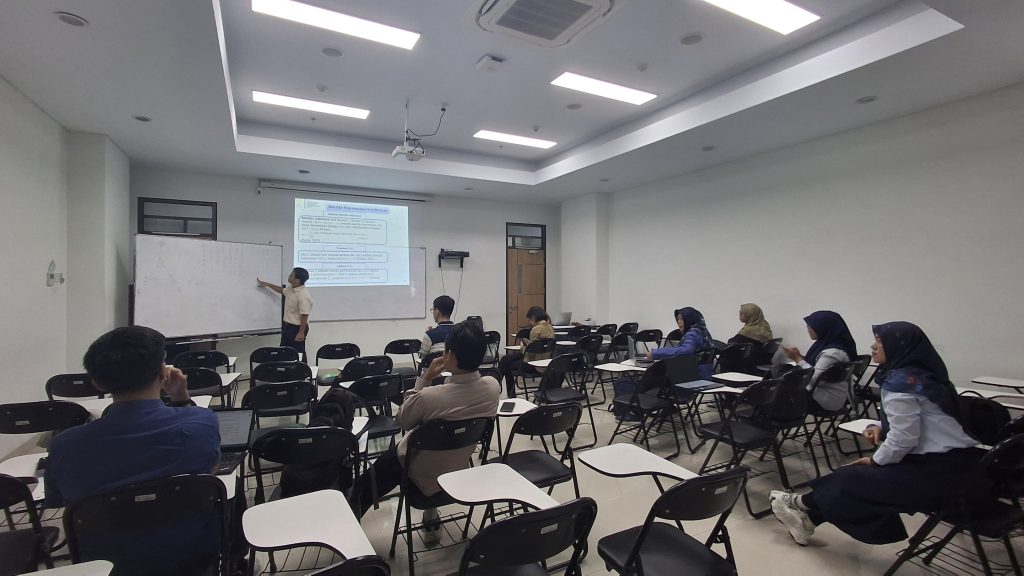
Furthermore, he introduced the concept of powering the adjacency matrix and explained its connection to graph theory. In particular, he showed that the entries of the k-th power of the adjacency matrix correspond to the number of distinct directed walks of length k in the graph. He illustrated how this relationship can be obtained and interpreted within the context of directed graphs.
Overall, the IDM 2026 event successfully combined academic discussion with personal reflection, providing participants with an opportunity to exchange research ideas while also acknowledging the realities and aspirations of the PhD journey.
#idm314 #IDM314