Speaker: 1. Dr. Ari Dwi Hartanto, Department of Mathematics, UGM
- Dr. Sri Rosdiana, Poltek, SSN
Date: 18/June/2025 Time: 13:00pm-15:00pm WIB
Platform: Zoom Meeting
Moderator: Dr. Solikhatun, Department of Mathematics, UGM

The Department of Mathematics, FMIPA UGM, in collaboration with Poltek Siber and Sandi Negara, held the first session of its Webinar Series titled “Cryptography in Your Daily Life” as part of a community service program. The event opened with remarks from Dr. Nanang Susyanto, Head of the Mathematics Department at UGM, who welcomed the participants and emphasized the importance of understanding cryptography in today’s digital world.

The first presentation was delivered by Dr. Ari Dwi Hartanto, who began by asking the basic question: What is cryptography? He explained how cryptography works in securing message delivery and introduced two main types of cryptography, classified by key type and by function. For key based classification, he explained symmetric key cryptography, which uses the same key for both encryption and decryption, and asymmetric key cryptography, which uses a public key for encryption and a private key for decryption. Examples he mentioned include the Shift Cipher, Hill Cipher, DES, and AES for symmetric key cryptography, and RSA for asymmetric key cryptography. He then discussed two functional types of cryptography: hash functions and digital signatures. He emphasized how hash functions help maintain data integrity, supported by real life examples. In the final part of his talk, Dr. Ari explained digital signatures, including DSA, which uses modular arithmetic and is based on the discrete logarithm problem, and ECDSA, which uses elliptic curve cryptography.
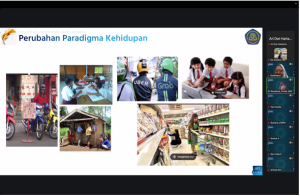
In the second session, Dr. Sri Rosdiana began with the questions: Why should information be secure? and Why and how is cryptography needed? She clearly explained the answers and highlighted the importance of cryptography in everyday life. She gave many examples, including the use of cryptography in internet communication, wireless local and area networks, mobile phones, secure payments and transaction cards, radio broadcasting, identity cards, anonymity protection, digital currency, and more. Her presentation helped the audience understand how cryptography plays a crucial role in protecting personal and public information in modern society.