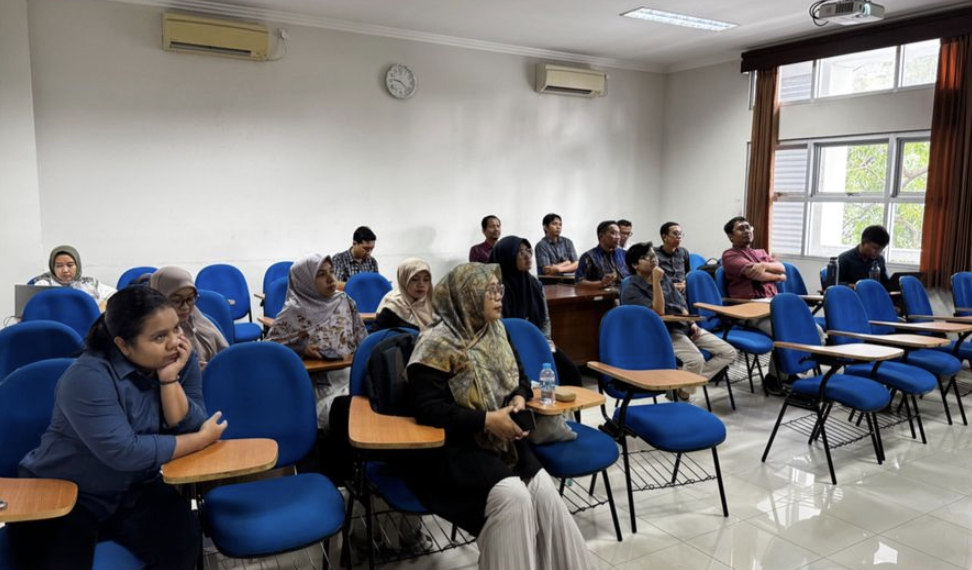
Speaker: Yosua Feri Wijaya
Topic: Partition Theory and an Introduction to Its Properties
Date: Wednesday, June 3, 2026
Time: 09.00 – 10.00 AM
Venue: Room 320 (Master’s/Doctoral Program in Mathematics), Building F, 3rd Floor
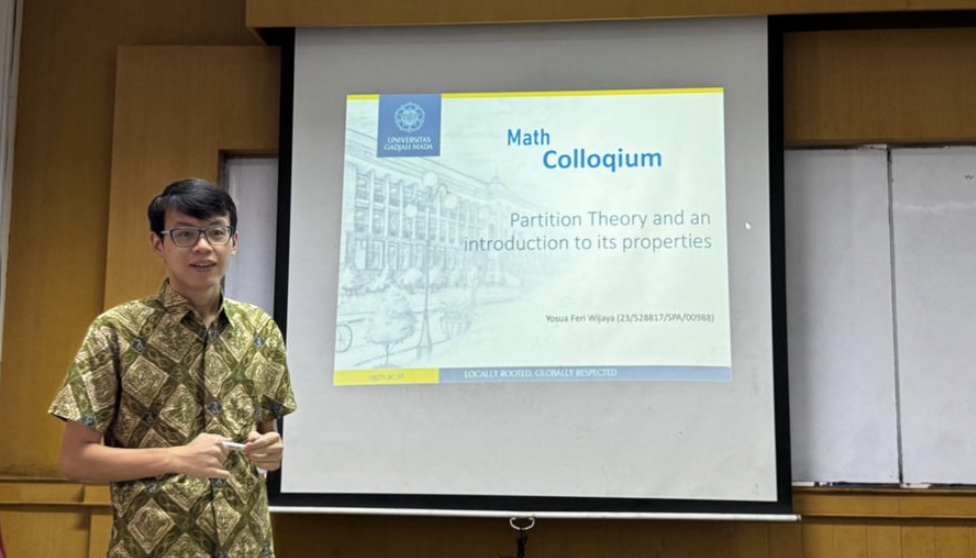
The Mathematics PhD Students Colloquium continued with a presentation by Yosua Feri Wijaya on the topic “Partition Theory and an Introduction to Its Properties.”
In his presentation, Yosua introduced the basic concepts of partition theory, one of the classical areas of number theory concerned with expressing a positive integer as a sum of positive integers. He explained several types of partitions and discussed how mathematicians study relationships between different classes of partitions.
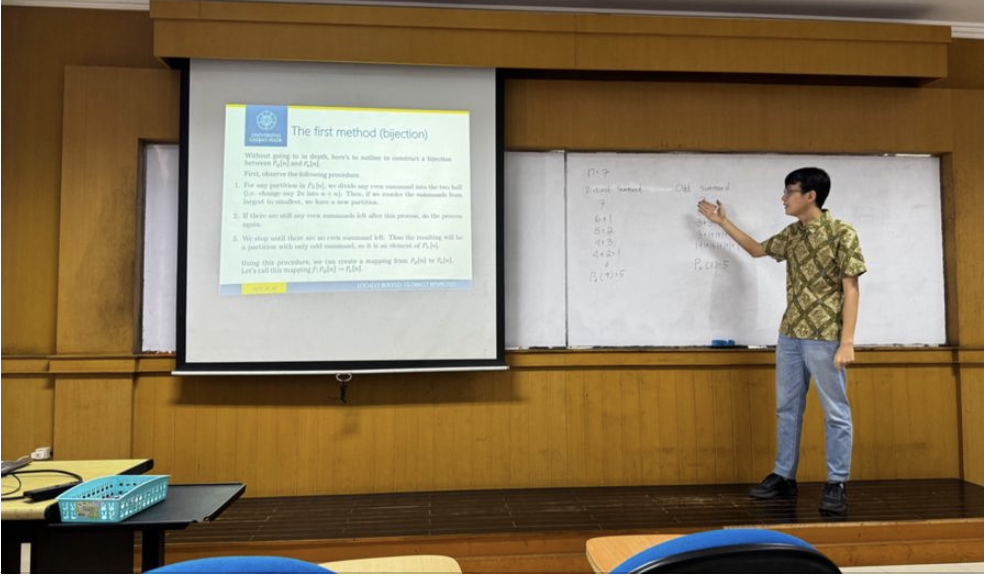
A major focus of the talk was a well-known result stating that the number of partitions of an integer into distinct parts is equal to the number of partitions into odd parts. To illustrate this result, he presented two common proof techniques in partition theory: constructing a bijection between the corresponding sets of partitions and using generating functions. Through several examples, he demonstrated how these methods reveal surprising connections between seemingly different partition structures.
The presentation then moved to another important aspect of partition theory: the study of patterns and congruence properties within partition functions. By examining numerical data, Yosua showed how mathematicians formulate conjectures regarding divisibility and other arithmetic properties of partition numbers. He also explained the role of generating functions as powerful tools for investigating such patterns and for computing partition values efficiently.
Throughout the talk, he emphasized that partition theory combines combinatorial arguments, algebraic techniques, and analytical methods, making it a rich area of mathematical research. The presentation provided participants with an accessible introduction to the subject while highlighting several classical problems and research directions in modern partition theory.