Speaker: Prof. Dr.rer.nat. Indah Emilia Wijayanti, S.Si., M.Si.
Topic: An Invitation to Category Theory: Seeing Mathematics Through Connections
Date: Wednesday, May 6, 2026.
Time: 09.30 – 11.30 AM
Venue: Room 320 (S2/S3 Mathematics), Building F, 3rd Floor, UGM.
Prof. Indah Emilia Wijayanti from our algebra laboratory presented at Frontiers in Mathematics #1 on the topic ” An Invitation to Category Theory: Seeing Mathematics Through Connections” .
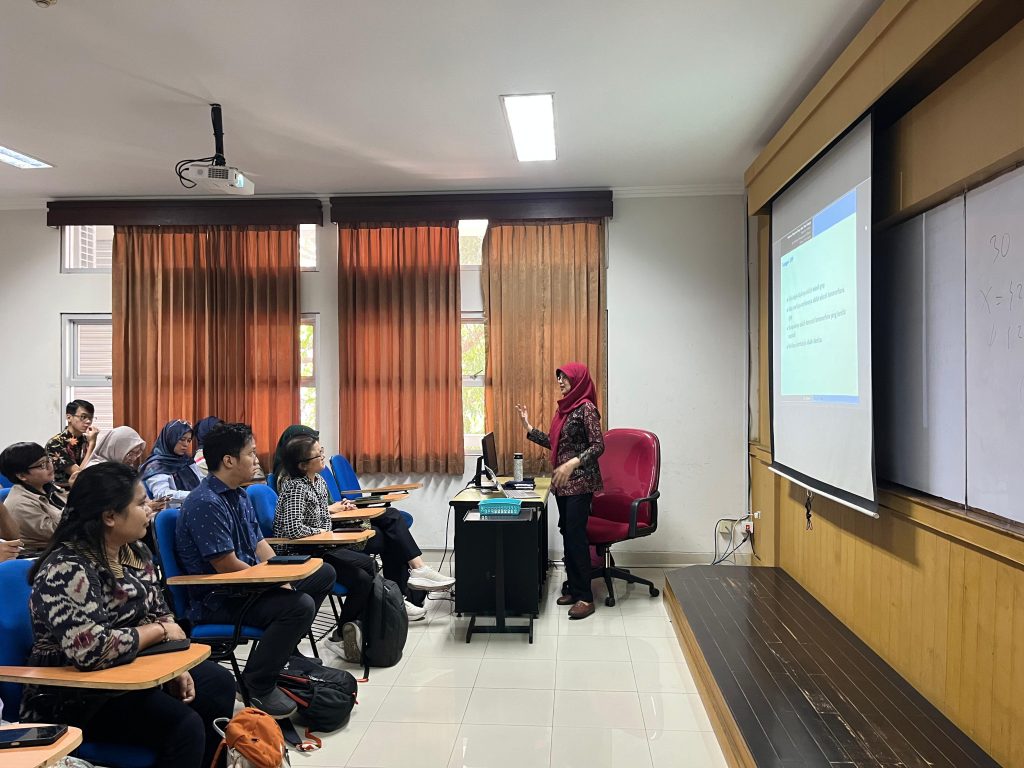
In her presentation, Prof. Indah first reviewed several basic notions in category theory before introducing the concept of pullback as a universal construction in a category. She explained the intuition behind pullback through commutative diagrams and illustrated how pullback can be viewed as an object that “synchronizes” two morphisms into a common structure.
She then provided several concrete examples of pullbacks in different mathematical settings. One example was the category of positive integers, where the least common multiple can be interpreted categorically as a pullback. She also discussed pullbacks in the category of commutative rings, describing the fibered product together with its associated commutative diagram.
To make the concept more intuitive, she explained how the graph of a function and the preimage of a subset can both be interpreted as pullbacks. She also showed that the intersection of ideals can be viewed categorically as a pullback construction, emphasizing that many algebraic concepts share the same universal pattern.
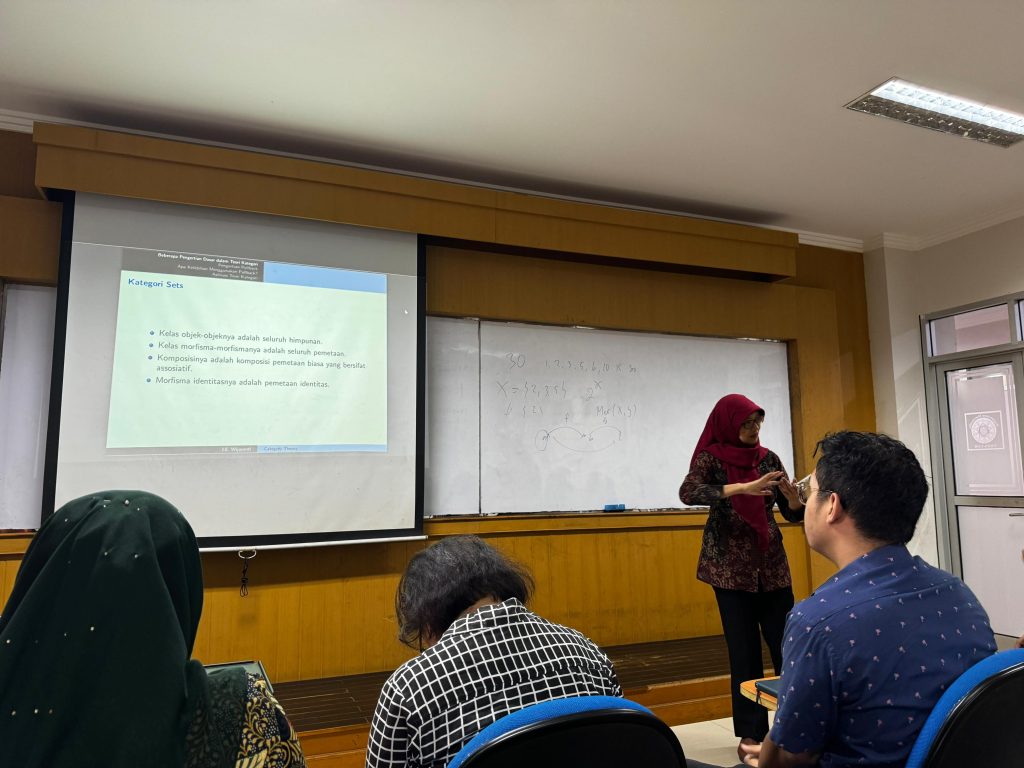
A significant part of the talk focused on the advantages of using pullbacks in mathematics. Prof. Indah explained that pullbacks unify many definitions in algebra under a single universal framework, provide conceptual justification for definitions such as kernels, and simplify proofs through universal properties. She also discussed how pullbacks remain stable under functors and help mathematicians understand structures through morphisms and relationships rather than only through elements.
In the later part of the presentation, she highlighted several applications of category theory in broader areas, including machine learning, programming languages such as Haskell, logic, sorting algorithms, computational category theory, and life sciences.
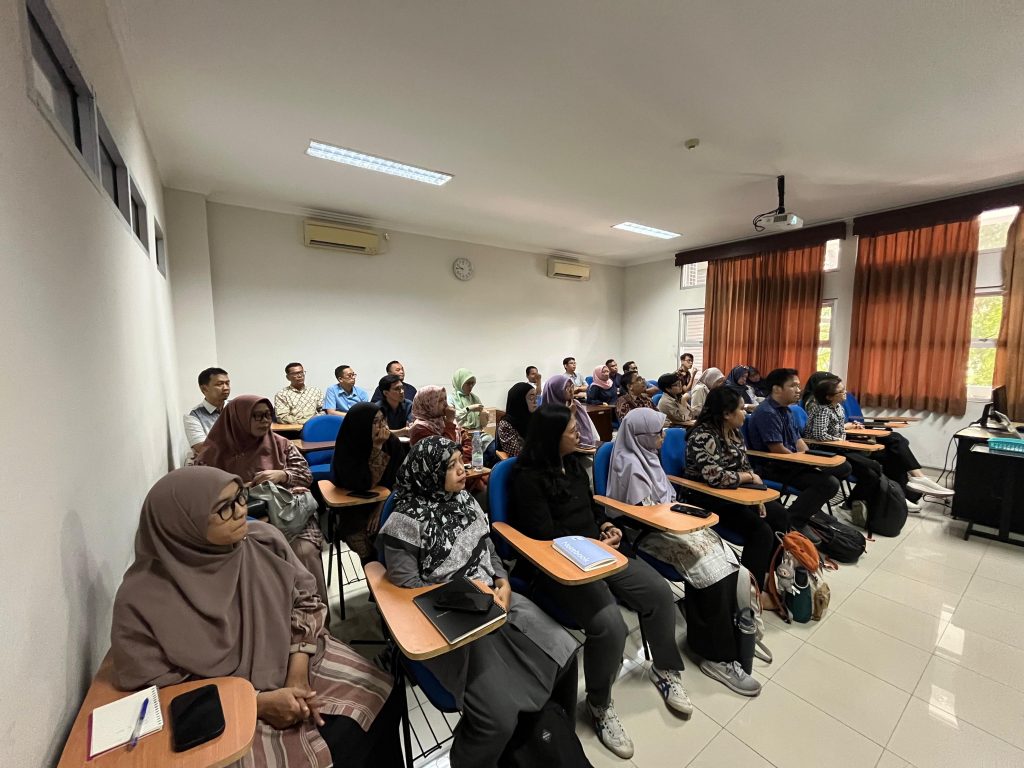 The colloquium concluded with the famous quote by Tom Leinster describing category theory as providing “a bird’s eye view of mathematics,” emphasizing how category theory reveals deep structural connections between different mathematical concepts.