Speaker: Dr. Muhammad Afifurrahman (UNSW Sydney, Australia)
Date: 8:30am-10am, June 11, 2026
Venue: Conference Room 1, 3rd Floor, Department of Mathematics, Universitas Gadjah Mada/Online via Zoom meeting
The Algebra Research Laboratory welcomed Dr. Muhammad Afifurrahman from the University of New South Wales (UNSW), Australia, for an Algebra Colloquium entitled “Arithmetic Statistics of Multiplicatively Dependent Vectors.” The talk introduced participants to a fascinating area at the intersection of number theory, algebra, and arithmetic statistics.
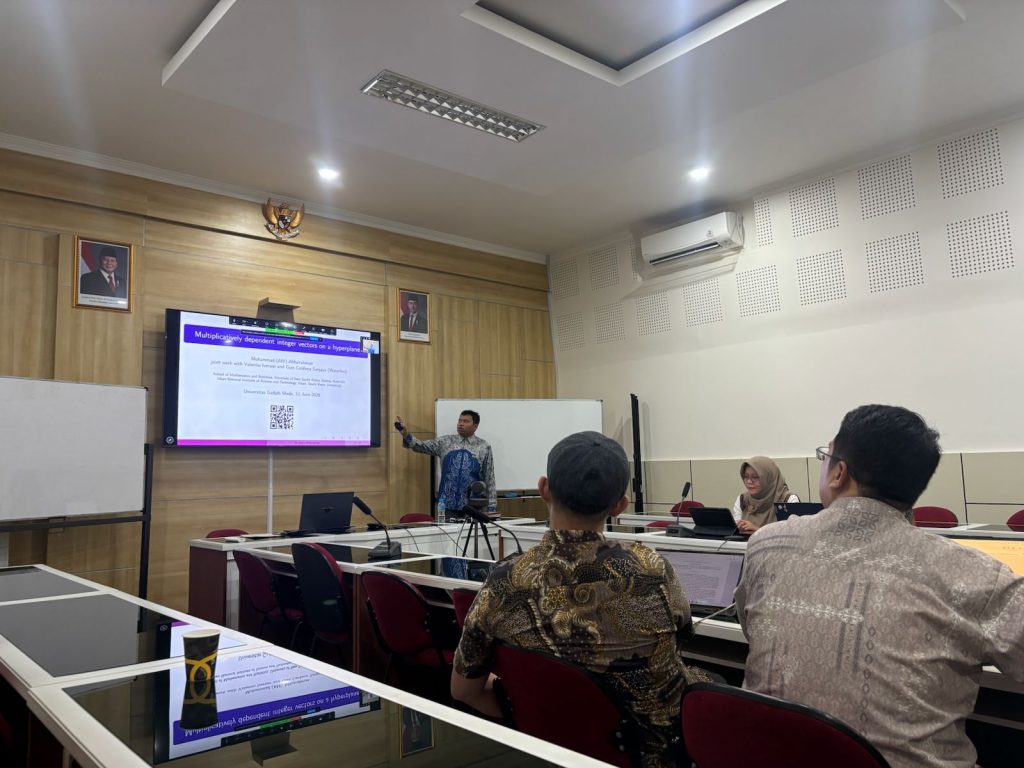
Dr. Afifurrahman began by explaining the notion of multiplicatively dependent vectors, which can be viewed as a multiplicative analogue of linear dependence. He continued to review earlier work concerning the distribution and counting of multiplicatively dependent vectors among integers and algebraic numbers.
The main focus of the presentation was the study of multiplicatively dependent integer vectors of bounded height that lie on a fixed hyperplane. Dr. Afifurrahman introduced the counting function associated with these vectors and explained the motivation behind obtaining asymptotic formulas describing their distribution. He highlighted how this problem extends previous results of Pappalardi, Sha, Shparlinski, and Stewart on multiplicatively dependent vectors.
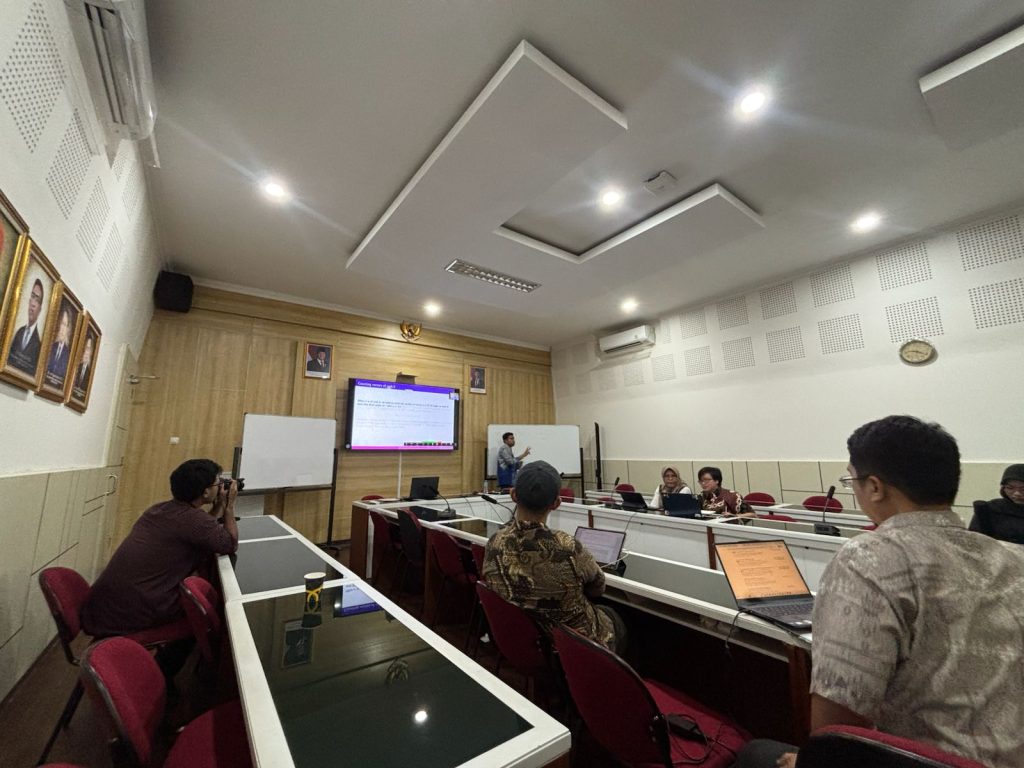
A significant part of the talk was devoted to presenting recent joint work with Valentio Iverson and Gian Cordana Sanjaya. Dr. Afifurrahman outlined their main theorem, which establishes an asymptotic formula for the number of multiplicatively dependent integer vectors on a hyperplane, together with explicit leading constants and error estimates.
To explain the strategy of the proof, he introduced the concept of the multiplicative rank of a vector and showed how the counting problem can be divided according to rank. He discussed techniques for estimating vectors of large rank and described how certain cases can be transformed into counting integer points on algebraic curves. This connection allowed the use of variants of the Bombieri–Pila determinant method to obtain strong upper bounds.
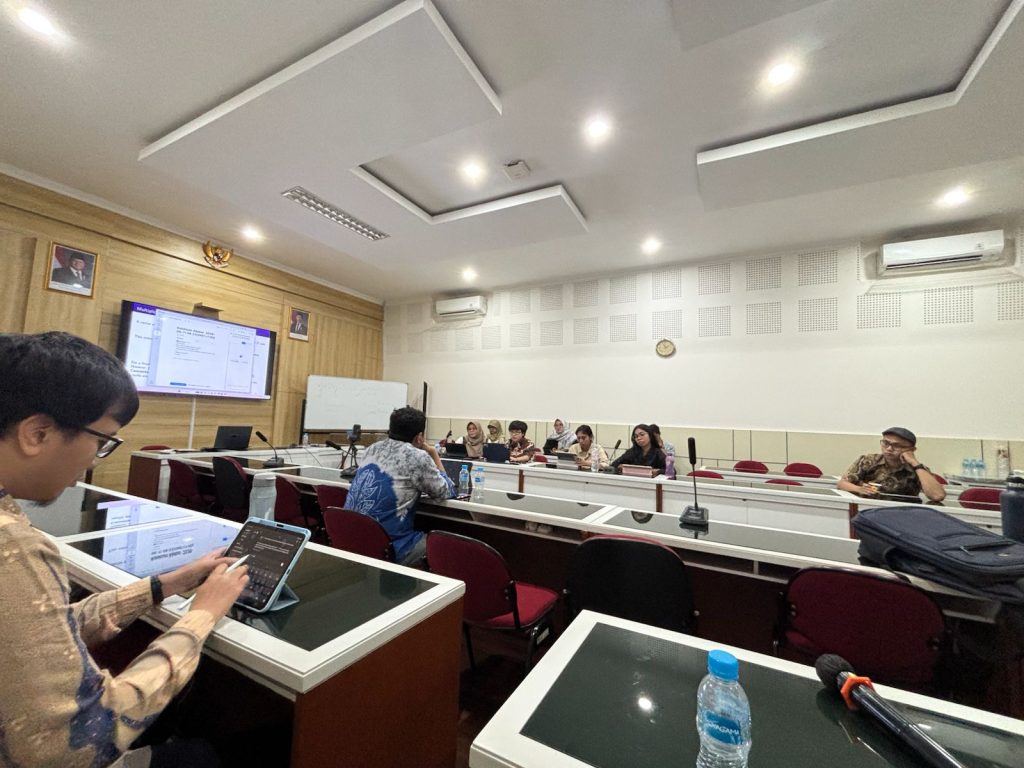
The colloquium concluded with a discussion of further directions and open problems, including extensions to algebraic integers, number fields, and more general varieties beyond hyperplanes. Dr. Afifurrahman also highlighted ongoing work aimed at developing new techniques for these broader settings.
The presentation provided participants with an accessible introduction to a modern research topic in arithmetic statistics while showcasing recent advances in the study of multiplicatively dependent vectors and their distribution on algebraic structures.